
Spouses with Different Tax Residencies

Greek couples living across borders often face complex tax questions—especially when one spouse is based abroad while the other remains in Greece. Until recently, the rules were unclear, but recent decisions by Greece’s Council of State have confirmed that spouses or civil partners can hold different tax residencies. This means one can be considered a Greek tax resident while the other is officially a non-dom (non-domiciled tax resident).
At TaxElements, we help couples navigate this specific legal landscape, from transferring tax residency to appointing a representative in Greece. In this post, we break down what you need to know to stay compliant and avoid unnecessary tax issues.
How Different Tax Residencies Work
Greek tax law now formally recognises that married couples or those in a civil partnership may reside—and be taxed—in separate jurisdictions. Provided one spouse meets the conditions to transfer tax residency abroad, they can be treated as a non-dom, even if their partner remains a Greek tax resident.
Despite living in different countries, couples continue to file a joint tax return (E1) in Greece. The non-dom spouse’s foreign tax residency is declared through pre-filled codes (319/320) on the return, based on information held by AADE (the Independent Authority for Public Revenue).This flexibility benefits couples where one partner relocates abroad and the other stays in Greece. It helps prevent double taxation and simplifies long-term planning.
What You Need to Transfer Tax Residency
The spouse applying for tax residency abroad must show they’ve genuinely established a new “centre of vital interests” outside Greece. AADE requires:
- Certificate of Tax Residency from the foreign country
- Employment documentation, such as a contract or employer letter
- Proof of accommodation abroad (owned or rented), with utility bills in the applicant’s name
- Foreign bank account statements
- Evidence of registration with a foreign tax or social security authority
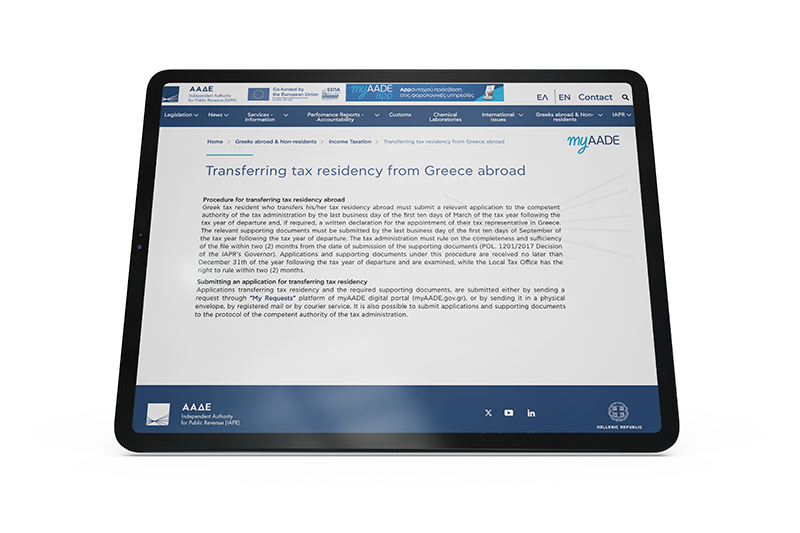
Applications must be filed by early March of the year following your move, with supporting documents submitted by early September. Retroactive tax residency changes are possible, but involve filing amended tax returns with full documentation—something TaxElements helps manage carefully to avoid delays or rejection.
Managing Tax Residence for Couples
Couples with one spouse moving abroad need to declare the spouse’s change of tax residence. This requires:
- Assessing Your Current Residential Status
- Notifying AADE
- Submitting Supporting Documents
- Appointing a Tax Representative for Spouse Moving Abroad
How TaxElements Can Help You
TaxElements supports spouses living across borders without tax implications. TaxElements is here to manage the paperwork, handle AADE communication, and ensure full compliance—so you can focus on your life, not your tax file.